what happens to a black hole that is accreting hydrogen gas from a nearby star?

An accretion disk is a structure (oft a circumstellar deejay) formed by diffuse material in orbital motion around a massive central body. The central body is typically a star. Friction, uneven irradiance, magnetohydrodynamic effects, and other forces induce instabilities causing orbiting material in the deejay to spiral inward towards the cardinal trunk. Gravitational and frictional forces compress and raise the temperature of the cloth, causing the emission of electromagnetic radiation. The frequency range of that radiation depends on the key object's mass. Accretion disks of young stars and protostars radiate in the infrared; those around neutron stars and black holes in the Ten-ray office of the spectrum. The study of oscillation modes in accretion disks is referred to equally diskoseismology.[1] [2]
Manifestations [edit]
Unsolved problem in physics:
Accretion disk jets: Why practise the disks surrounding sure objects, such as the nuclei of active galaxies, emit jets forth their polar axes? These jets are invoked by astronomers to do everything from getting rid of athwart momentum in a forming star to reionizing the universe (in agile galactic nuclei), just their origin is still not well understood.
Accretion disks are a ubiquitous miracle in astrophysics; active galactic nuclei, protoplanetary disks, and gamma ray bursts all involve accretion disks. These disks very often give ascension to astrophysical jets coming from the vicinity of the key object. Jets are an efficient way for the star-disk organisation to shed angular momentum without losing too much mass.
The about spectacular accretion disks found in nature are those of active galactic nuclei and of quasars, which are idea to be massive black holes at the center of galaxies. As thing enters the accretion disc, it follows a trajectory called a tendex line, which describes an inward screw. This is considering particles rub and bounce against each other in a turbulent flow, causing frictional heating which radiates free energy abroad, reducing the particles' angular momentum, allowing the particle to drift inwards, driving the inward screw. The loss of angular momentum manifests as a reduction in velocity; at a slower velocity, the particle must adopt a lower orbit. As the particle falls to this lower orbit, a portion of its gravitational potential energy is converted to increased velocity and the particle gains speed. Thus, the particle has lost energy even though it is now travelling faster than earlier; notwithstanding, it has lost angular momentum. As a particle orbits closer and closer, its velocity increases, as velocity increases frictional heating increases equally more than and more than of the particle's potential free energy (relative to the black pigsty) is radiated away; the accession disk of a black pigsty is hot enough to emit X-rays merely exterior the event horizon. The big luminosity of quasars is believed to be a result of gas being accreted by supermassive black holes.[3] Elliptical accretion disks formed at tidal disruption of stars can be typical in galactic nuclei and quasars.[4] Accretion process can convert about ten percent to over 40 percent of the mass of an object into energy every bit compared to around 0.7 percent for nuclear fusion processes.[5] In close binary systems the more massive chief component evolves faster and has already become a white dwarf, a neutron star, or a black pigsty, when the less massive companion reaches the giant country and exceeds its Roche lobe. A gas flow so develops from the companion star to the main. Angular momentum conservation prevents a straight flow from ane star to the other and an accretion disk forms instead.
Accession disks surrounding T Tauri stars or Herbig stars are called protoplanetary disks because they are thought to be the progenitors of planetary systems. The accreted gas in this instance comes from the molecular cloud out of which the star has formed rather than a companion star.
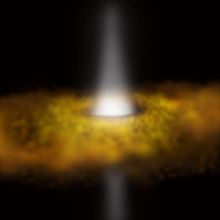
Creative person's view of a star with accession disk
This animation of supercomputer data takes you lot to the inner zone of the accession deejay of a stellar-mass blackness hole.
This video shows an artist's impression of the dusty wind emanating from the black hole at the eye of milky way NGC 3783.
Accretion deejay physics [edit]

Creative person's conception of a black hole drawing affair from a nearby star, forming an accretion disk.
In the 1940s, models were first derived from bones physical principles.[6] In social club to agree with observations, those models had to invoke a yet unknown mechanism for angular momentum redistribution. If matter is to autumn inwards it must lose not only gravitational energy but too lose angular momentum. Since the full athwart momentum of the deejay is conserved, the angular momentum loss of the mass falling into the heart has to be compensated by an angular momentum gain of the mass far from the center. In other words, athwart momentum should exist transported outwards for thing to accrete. Co-ordinate to the Rayleigh stability benchmark,
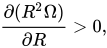
where represents the angular velocity of a fluid element and its altitude to the rotation center, an accession disk is expected to be a laminar flow. This prevents the beingness of a hydrodynamic mechanism for athwart momentum send.


On one hand, information technology was articulate that viscous stresses would eventually cause the matter towards the centre to heat upward and radiate away some of its gravitational free energy. On the other hand, viscosity itself was non enough to explain the transport of angular momentum to the exterior parts of the deejay. Turbulence-enhanced viscosity was the mechanism thought to exist responsible for such angular-momentum redistribution, although the origin of the turbulence itself was not well understood. The conventional -model (discussed below) introduces an adjustable parameter describing the effective increment of viscosity due to turbulent eddies inside the disk.[7] [eight] In 1991, with the rediscovery of the magnetorotational instability (MRI), S. A. Balbus and J. F. Hawley established that a weakly magnetized disk accreting around a heavy, meaty cardinal object would be highly unstable, providing a direct mechanism for angular-momentum redistribution.[9]

α-Disk model [edit]
Shakura and Sunyaev (1973)[7] proposed turbulence in the gas as the source of an increased viscosity. Assuming subsonic turbulence and the disk height as an upper limit for the size of the eddies, the deejay viscosity can be estimated every bit where is the sound speed, is the scale tiptop of the disk, and is a gratuitous parameter between zero (no accretion) and approximately one. In a turbulent medium , where is the velocity of turbulent cells relative to the mean gas motion, and is the size of the largest turbulent cells, which is estimated every bit and , where is the Keplerian orbital angular velocity, is the radial distance from the key object of mass .[10] Past using the equation of hydrostatic equilibrium, combined with conservation of angular momentum and assuming that the deejay is thin, the equations of disk structure may be solved in terms of the parameter. Many of the observables depend only weakly on , so this theory is predictive even though it has a complimentary parameter.










Using Kramers' opacity law it is found that



where and are the mid-aeroplane temperature and density respectively. is the accretion charge per unit, in units of , is the mass of the central accreting object in units of a solar mass, , is the radius of a point in the disk, in units of , and , where is the radius where angular momentum stops beingness transported inward.


![f=\left[1-\left(\frac{R_\star}{R}\right)^{1/2} \right]^{1/4}](https://wikimedia.org/api/rest_v1/media/math/render/svg/2e053781dbfdf610a0e7cfead8b17c202f83f0f6)

The Shakura–Sunyaev α-disk model is both thermally and viscously unstable. An culling model, known equally the -disk, which is stable in both senses assumes that the viscosity is proportional to the gas pressure .[11] [12] In the standard Shakura–Sunyaev model, viscosity is causeless to be proportional to the total force per unit area since .




The Shakura–Sunyaev model assumes that the disk is in local thermal equilibrium, and can radiate its rut efficiently. In this case, the disk radiates away the viscous rut, cools, and becomes geometrically thin. Notwithstanding, this assumption may interruption downwards. In the radiatively inefficient case, the disk may "puff up" into a torus or some other iii-dimensional solution similar an Advection Dominated Accession Flow (ADAF). The ADAF solutions usually require that the accretion rate is smaller than a few percent of the Eddington limit. Another farthermost is the example of Saturn's rings, where the disk is so gas poor that its angular momentum send is dominated by solid body collisions and disk-moon gravitational interactions. The model is in understanding with contempo astrophysical measurements using gravitational lensing.[xiii] [xiv] [xv] [16]
Magnetorotational instability [edit]

Balbus and Hawley (1991)[ix] proposed a mechanism which involves magnetic fields to generate the angular momentum transport. A unproblematic organization displaying this mechanism is a gas disk in the presence of a weak centric magnetic field. Two radially neighboring fluid elements volition behave equally 2 mass points connected past a massless bound, the spring tension playing the office of the magnetic tension. In a Keplerian deejay the inner fluid element would be orbiting more rapidly than the outer, causing the leap to stretch. The inner fluid chemical element is then forced by the spring to slow down, reduce correspondingly its angular momentum causing it to move to a lower orbit. The outer fluid element beingness pulled forward volition speed up, increasing its angular momentum and move to a larger radius orbit. The spring tension will increment every bit the two fluid elements move further apart and the process runs away.[17]
Information technology can exist shown that in the presence of such a spring-like tension the Rayleigh stability criterion is replaced by

Nigh astrophysical disks do non meet this criterion and are therefore decumbent to this magnetorotational instability. The magnetic fields present in astrophysical objects (required for the instability to occur) are believed to exist generated via dynamo action.[18]
Magnetic fields and jets [edit]
Accretion disks are commonly assumed to be threaded by the external magnetic fields nowadays in the interstellar medium. These fields are typically weak (virtually few micro-Gauss), merely they tin can become anchored to the matter in the disk, because of its loftier electrical conductivity, and carried inward toward the central star. This process can concentrate the magnetic flux around the centre of the disk giving rise to very stiff magnetic fields. Formation of powerful astrophysical jets along the rotation axis of accretion disks requires a large scale poloidal magnetic field in the inner regions of the disk.[19]
Such magnetic fields may be advected inward from the interstellar medium or generated by a magnetic dynamo inside the disk. Magnetic fields strengths at least of society 100 Gauss seem necessary for the magneto-centrifugal mechanism to launch powerful jets. There are problems, nonetheless, in carrying external magnetic flux inward towards the primal star of the deejay.[twenty] High electric conductivity dictates that the magnetic field is frozen into the thing which is being accreted onto the central object with a slow velocity. However, the plasma is not a perfect electric conductor, so there is always some degree of dissipation. The magnetic field diffuses abroad faster than the rate at which it is existence carried inward past accretion of matter.[21] A simple solution is assuming a viscosity much larger than the magnetic diffusivity in the disk. However, numerical simulations, and theoretical models, show that the viscosity and magnetic diffusivity have almost the same social club of magnitude in magneto-rotationally turbulent disks.[22] Some other factors may possibly impact the advection/diffusion charge per unit: reduced turbulent magnetic improvidence on the surface layers; reduction of the Shakura–Sunyaev viscosity by magnetic fields;[23] and the generation of big scale fields by pocket-sized calibration MHD turbulence –a big scale dynamo. In fact, a combination of different mechanisms might be responsible for efficiently carrying the external field inwards towards the primal parts of the disk where the jet is launched. Magnetic buoyancy, turbulent pumping and turbulent diamagnetism exemplify such physical phenomena invoked to explain such efficient concentration of external fields.[24]
Analytic models of sub-Eddington accession disks (sparse disks, ADAFs) [edit]
When the accretion charge per unit is sub-Eddington and the opacity very high, the standard thin accretion disk is formed. It is geometrically sparse in the vertical direction (has a deejay-like shape), and is made of a relatively cold gas, with a negligible radiation pressure. The gas goes down on very tight spirals, resembling almost circular, almost free (Keplerian) orbits. Thin disks are relatively luminous and they take thermal electromagnetic spectra, i.eastward. not much different from that of a sum of blackness bodies. Radiative cooling is very efficient in thin disks. The classic 1974 work past Shakura and Sunyaev on thin accession disks is 1 of the most often quoted papers in modernistic astrophysics. Thin disks were independently worked out by Lynden-Bong, Pringle and Rees. Pringle contributed in the by xxx years many key results to accretion disk theory, and wrote the classic 1981 review that for many years was the main source of information nearly accretion disks, and is still very useful today.

Simulation by J.A. Marck of optical appearance of Schwarzschild blackness hole with sparse (Keplerian) disk.
A fully general relativistic treatment, every bit needed for the inner part of the disk when the central object is a black pigsty, has been provided past Page and Thorne,[25] and used for producing imitation optical images by Luminet[26] and Marck,[27] in which, although such a organization is intrinsically symmetric its image is not, because the relativistic rotation speed needed for centrifugal equilibrium in the very strong gravitational field near the blackness pigsty produces a strong Doppler redshift on the receding side (taken here to exist on the correct) whereas there will be a strong blueshift on the approaching side. Due to low-cal bending, the disk appears distorted merely is nowhere subconscious by the black hole.
When the accession rate is sub-Eddington and the opacity very depression, an ADAF is formed. This type of accession disk was predicted in 1977 by Ichimaru. Although Ichimaru'southward paper was largely ignored, some elements of the ADAF model were present in the influential 1982 ion-tori paper by Rees, Phinney, Begelman and Blandford. ADAFs started to be intensely studied by many authors only afterward their rediscovery in the mid-1990 by Narayan and Yi, and independently by Abramowicz, Chen, Kato, Lasota (who coined the name ADAF), and Regev. Most important contributions to astrophysical applications of ADAFs have been made by Narayan and his collaborators. ADAFs are cooled by advection (heat captured in matter) rather than by radiation. They are very radiatively inefficient, geometrically extended, similar in shape to a sphere (or a "corona") rather than a disk, and very hot (close to the virial temperature). Because of their low efficiency, ADAFs are much less luminous than the Shakura–Sunyaev thin disks. ADAFs emit a power-constabulary, non-thermal radiation, ofttimes with a strong Compton component.

Black hole with corona, an Ten-ray source (artist's concept).[28]

Blurring of 10-rays near Black pigsty (NuSTAR; 12 Baronial 2014).[28]
Analytic models of super-Eddington accretion disks (slim disks, Polish doughnuts) [edit]
The theory of highly super-Eddington black hole accession, Thousand≫M Edd, was developed in the 1980s past Abramowicz, Jaroszynski, Paczyński, Sikora and others in terms of "Polish doughnuts" (the name was coined by Rees). Polish doughnuts are low viscosity, optically thick, radiation pressure level supported accretion disks cooled past advection. They are radiatively very inefficient. Polish doughnuts resemble in shape a fat torus (a doughnut) with two narrow funnels along the rotation centrality. The funnels collimate the radiations into beams with highly super-Eddington luminosities.
Slim disks (proper name coined by Kolakowska) have only moderately super-Eddington accession rates, M≥M Edd, rather deejay-like shapes, and nearly thermal spectra. They are cooled past advection, and are radiatively ineffective. They were introduced by Abramowicz, Lasota, Czerny and Szuszkiewicz in 1988.
Unsolved problem in physics:
Accretion disk QPO's: Quasi-Periodic Oscillations happen in many accretion disks, with their periods appearing to scale equally the inverse of the mass of the central object. Why do these oscillations exist? Why are there sometimes overtones, and why do these appear at different frequency ratios in different objects?
Excretion disk [edit]
The opposite of an accretion disk is an excretion disk where instead of textile accreting from a deejay on to a central object, material is excreted from the center outwards on to the deejay. Excretion disks are formed when stars merge.[29]
See also [edit]
- Accretion
- Astrophysical jet
- Blandford–Znajek process
- Circumstellar disk
- Circumplanetary deejay – Aggregating of affair around a planet
- Dynamo theory
- Gravitational singularity
- Planetary ring
- Quasi-star
- Solar nebula
- Spin-flip
References [edit]
- ^ Nowak, Michael A.; Wagoner, Robert 5. (1991). "Diskoseismology: Probing accretion disks. I - Trapped adiabatic oscillations". Astrophysical Journal. 378: 656–664. Bibcode:1991ApJ...378..656N. doi:x.1086/170465.
- ^ Wagoner, Robert 5. (2008). "Relativistic and Newtonian diskoseismology". New Astronomy Reviews. 51 (10–12): 828–834. Bibcode:2008NewAR..51..828W. doi:10.1016/j.newar.2008.03.012.
- ^ Lynden-Bell, D. (1969). "Galactic Nuclei as Collapsed Old Quasars". Nature. 280 (5207): 690–694. Bibcode:1969Natur.223..690L. doi:x.1038/223690a0. S2CID 4164497.
- ^ Gurzadyan, V. G.; Ozernoy, L. M. (1979). "Accretion on massive blackness holes in galactic nuclei". Nature. 280 (5719): 214–215. Bibcode:1979Natur.280..214G. doi:10.1038/280214a0. S2CID 4306883.
- ^ Massi, Maria. "Accretion" (PDF). Archived (PDF) from the original on 2020-12-02. Retrieved 2018-07-22 .
- ^ Weizsäcker, C. F. (1948). "Die Rotation Kosmischer Gasmassen" [The rotation of cosmic gas masses]. Zeitschrift für Naturforschung A (in German). three (eight–11): 524–539. Bibcode:1948ZNatA...3..524W. doi:10.1515/zna-1948-8-1118.
- ^ a b Shakura, N. I.; Sunyaev, R. A. (1973). "Black Holes in Binary Systems. Observational Appearance". Astronomy and Astrophysics. 24: 337–355. Bibcode:1973A&A....24..337S.
- ^ Lynden-Bell, D.; Pringle, J. E. (1974). "The evolution of viscous discs and the origin of the nebular variables". Monthly Notices of the Royal Astronomical Society. 168 (3): 603–637. Bibcode:1974MNRAS.168..603L. doi:10.1093/mnras/168.3.603.
- ^ a b Balbus, Steven A.; Hawley, John F. (1991). "A powerful local shear instability in weakly magnetized disks. I – Linear assay". Astrophysical Journal. 376: 214–233. Bibcode:1991ApJ...376..214B. doi:10.1086/170270.
- ^ Landau, L. D.; Lishitz, E. M. (1959). Fluid Mechanics. Vol. 6 (Reprint 1st ed.). Pergamon Press. ISBN978-0-08-009104-iv. [ folio needed ]
- ^ Lightman, Alan P.; Eardley, Douglas M. (1974). "Black Holes in Binary Systems: Instability of Disk Accretion". The Astrophysical Journal. 187: L1. Bibcode:1974ApJ...187L...1L. doi:10.1086/181377.
- ^ Piran, T. (1978). "The office of viscosity and cooling mechanisms in the stability of accretion disks". The Astrophysical Journal. 221: 652. Bibcode:1978ApJ...221..652P. doi:10.1086/156069.
- ^ Poindexter, Shawn; Morgan, Nicholas; Kochanek, Christopher S. (2008). "The Spatial Structure of An Accretion Disk". The Astrophysical Journal. 673 (1): 34–38. arXiv:0707.0003. Bibcode:2008ApJ...673...34P. doi:ten.1086/524190. S2CID 7699211.
- ^ Eigenbrod, A.; Courbin, F.; Meylan, K.; Agol, E.; Anguita, T.; Schmidt, R. W.; Wambsganss, J. (2008). "Microlensing variability in the gravitationally lensed quasar QSO 2237+0305=the Einstein Cross. Two. Energy contour of the accretion disk". Astronomy & Astrophysics. 490 (3): 933–943. arXiv:0810.0011. Bibcode:2008A&A...490..933E. doi:10.1051/0004-6361:200810729. S2CID 14230245.
- ^ Mosquera, A. One thousand.; Muñoz, J. A.; Mediavilla, Eastward. (2009). "Detection of chromatic microlensing in Q 2237+0305 A". The Astrophysical Journal. 691 (2): 1292–1299. arXiv:0810.1626. Bibcode:2009ApJ...691.1292M. doi:10.1088/0004-637X/691/2/1292. S2CID 15724872.
- ^ Floyd, David J. E.; Bate, N. F.; Webster, R. L. (2009). "The accretion disc in the quasar SDSS J0924+0219". Monthly Notices of the Royal Astronomical Society. 398 (1): 233–239. arXiv:0905.2651. Bibcode:2009MNRAS.398..233F. doi:10.1111/j.1365-2966.2009.15045.ten. S2CID 18381541.
- ^ Balbus, Steven A. (2003), "Enhanced Athwart Momentum Transport in Accretion Disks", Annu. Rev. Astron. Astrophys. (Submitted manuscript), 41 (1): 555–597, arXiv:astro-ph/0306208, Bibcode:2003ARA&A..41..555B, doi:10.1146/annurev.astro.41.081401.155207, S2CID 45836806, archived from the original on 2018-11-06, retrieved 2018-09-02
- ^ Rüdiger, Günther; Hollerbach, Rainer (2004), The Magnetic Universe: Geophysical and Astrophysical Dynamo Theory , Wiley-VCH, ISBN978-3-527-40409-four [ page needed ]
- ^ Blandford, Roger; Payne, David (1982). "Hydromagnetic flows from accretion discs and the production of radio jets". Monthly Notices of the Royal Astronomical Order. 199 (four): 883–903. Bibcode:1982MNRAS.199..883B. doi:10.1093/mnras/199.iv.883.
- ^ Beckwith, Kris; Hawley, John F.; Krolik, Julian H. (2009). "Transport of large-calibration poloidal flux in blackness pigsty accession". Astrophysical Journal. 707 (1): 428–445. arXiv:0906.2784. Bibcode:2009ApJ...707..428B. doi:x.1088/0004-637x/707/1/428. S2CID 18517137.
- ^ Park, Seok Jae; Vishniac, Ethan (1996). "The Variability of Agile Galactic Nuclei and the Radial Transport of Vertical Magnetic Flux". Astrophysical Journal. 471: 158–163. arXiv:astro-ph/9602133. Bibcode:1996ApJ...471..158P. doi:10.1086/177959. S2CID 18002375.
- ^ Guan, Xiaoyue; Gammie, Charles F. (2009). "The turbulent magnetic Prandtl number of MHD turbulence in disks". Astrophysical Journal. 697 (2): 1901–1906. arXiv:0903.3757. Bibcode:2009ApJ...697.1901G. doi:10.1088/0004-637x/697/ii/1901. S2CID 18040227.
- ^ Shakura, N. I.; Sunyaev, R. A (1973). "Black holes in binary systems. Observational appearance". Astronomy and Astrophysics. 24: 337–355. Bibcode:1973A&A....24..337S.
- ^ Jafari, Amir; Vishniac, Ethan (2018). "Magnetic field transport in accretion disks". The Astrophysical Journal. 854 (1): 2. Bibcode:2018ApJ...854....2J. doi:10.3847/1538-4357/aaa75b.
- ^ Page, D. N.; Thorne, K. Southward. (1974). "Disk-Accession onto a Blackness Hole. Time-Averaged Structure of Accession Disk". Astrophys. J. 191 (2): 499–506. Bibcode:1974ApJ...191..499P. doi:x.1086/152990.
- ^ Luminet, J. P. (1979). "Image of a spherical black hole with thin accession deejay". Astron. Astrophys. 75 (ane–two): 228–235. Bibcode:1979A&A....75..228L.
- ^ Marck, J. A. (1996). "Short-cut method of solution of geodesic equations for Schwarzchild black pigsty". Course. Breakthrough Grav. 13 (3): 393–. arXiv:gr-qc/9505010. Bibcode:1996CQGra..thirteen..393M. doi:10.1088/0264-9381/13/3/007. S2CID 119508131.
- ^ a b Clavin, Whitney; Harrington, J.D. (12 August 2014). "NASA'southward NuSTAR Sees Rare Blurring of Black Hole Light". NASA. Archived from the original on thirteen August 2014. Retrieved 12 August 2014.
- ^ Poindexter, Shawn; Morgan, Nicholas; Kochanek, Christopher Southward (2011). "A binary merger origin for inflated hot Jupiter planets". Astronomy & Astrophysics. 535: A50. arXiv:1102.3336. Bibcode:2011A&A...535A..50M. doi:10.1051/0004-6361/201116907. S2CID 118473108.
- Frank, Juhan; Andrew Male monarch; Derek Raine (2002), Accretion power in astrophysics (Third ed.), Cambridge University Press, ISBN978-0-521-62957-7
- Krolik, Julian H. (1999), Agile Galactic Nuclei, Princeton Academy Press, ISBN978-0-691-01151-6
External links [edit]
- Professor John F. Hawley homepage
- Nonradiative Black Hole Accretion
- Accretion Discs on Scholarpedia
- Merali, Zeeya (21 June 2006). "Magnetic fields snare black holes' food". New Scientist.
Source: https://en.wikipedia.org/wiki/Accretion_disk
0 Response to "what happens to a black hole that is accreting hydrogen gas from a nearby star?"
Post a Comment